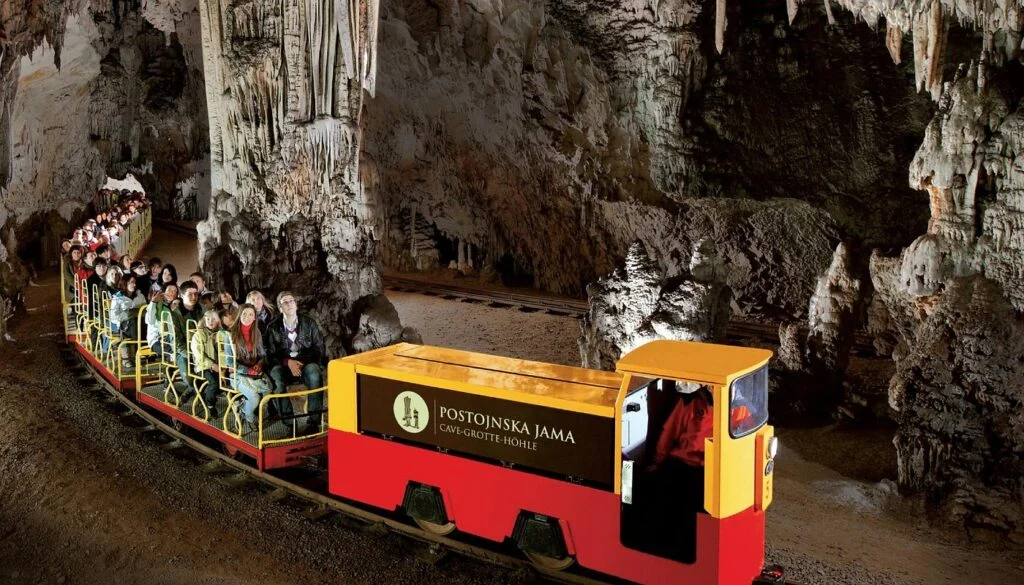
Slovenia has two world-class caves, and they are so different that choosing between them isn't a question of budget — it's a question of what you want from your trip. Postojna is a top-tier attraction. Škocjan is a UNESCO World Heritage Site and a natural spectacle of an entirely different order.
Postojna Cave: Comfort and Scale
Twenty-four kilometres of passages, five of which are open to visitors. The highlight is the underground train: open carriages carry you roughly three and a half kilometres into the mountain. Kids absolutely love it, and the ride itself is just as memorable as the chambers.
Inside, you'll find the Concert Hall with exceptional acoustics — real concerts are held there — and the famous Brilliant, a five-metre white stalagmite that has become a symbol of Slovenian tourism.
There's also the vivarium housing olms, blind cave salamanders. These creatures can live up to a hundred years, survive years without food, and are found only in the underground waters of the Dinaric Karst.
Postojna is fully equipped for visitors: paved paths, lighting, lifts, and partial wheelchair access. The flip side is the crowds and the feeling of a well-oiled tourist machine.
Škocjan Caves: Nature in the Raw
No train, no Brilliant. What you get instead is an underground canyon carved by the Reka River — one of the largest known in the world. The chamber reaches depths of around a hundred and fifty metres, and you cross it on a bridge as part of the tour.
The experience is fundamentally different: you walk, you hear the roar of the river below, and the sheer scale hits you physically. Photography is not allowed inside — annoying at first, but you quickly realise it makes you actually look rather than just shoot.
Škocjan has been on the UNESCO list since 1986. The route requires reasonable fitness: around one and a half to two hours, staircases, significant elevation changes, and slippery sections.
Which One to Choose
Travelling with children, elderly parents, or with limited mobility — Postojna. The train, flat paths, and a short, easy route make it the right call.
If you want a raw natural experience rather than an attraction — Škocjan. Especially if you've visited caves before and standard stalactites no longer impress you.
If you only have time for one visit and it's your first time in the region — Postojna, because nearby Predjama Castle, built into a cliff face, makes for a perfect combined day trip.
Can You Do Both in One Day
Technically yes: they're about thirty kilometres apart, roughly half an hour by car. In practice it's tough — two underground routes back to back are exhausting and the impressions blur together. If you're set on it, start at Škocjan in the morning while you still have energy for the walking sections.
An organised trip to Postojna Cave usually includes Predjama Castle as well, which takes the hassle out of timing the cave train — its schedule changes by season.
Practical Tips for Both Caves
Temperature. Around ten degrees year-round. A jacket is essential no matter how hot it is outside.
Footwear. Non-slip soles, especially for Škocjan.
Tickets. In high season, book Postojna online in advance: groups are time-slotted and morning entries fill up fast.
To find a cave visit option that fits your dates, check route planner.
FAQ
Which cave in Slovenia is the most famous?
Postojna — thanks to its underground train, acoustically exceptional concert hall, and the Brilliant stalagmite. Škocjan Caves are less widely marketed but hold UNESCO World Heritage status.
What is the temperature inside the caves?
Around ten degrees year-round, regardless of the weather outside. Even in thirty-degree heat you'll need a jacket, and the tour takes at least an hour and a half.
Are the caves suitable for children?
Postojna — yes, the train and flat paths make it very family-friendly. Škocjan requires physical fitness: staircases, elevation changes, and a bridge over the canyon make it tough with young children.
🌍 Ready to explore Slovenia and Italy?
Build your itinerary in 3 minutes or pick a ready-made tour