Trieste doesn't look like the rest of Italy — and that's exactly what makes it special. Until 1918, it was the main port of the Austro-Hungarian Empire, and the city was built for that role: wide boulevards, Viennese facades, Habsburg-style coffee houses. The Italian Italy starts further south; here, it's Central Europe with a view of the Adriatic.
From the Slovenian border to the center of Trieste is a twenty-minute drive, making it the most convenient day trip from Koper or Škofje.
Piazza Unità d’Italia
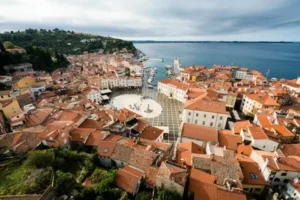
The largest sea-facing square in Europe. Three sides are lined with palaces; the fourth opens onto the bay. At night the lights come on, and the square becomes the beating heart of the city. It's the perfect place to start your visit.
Nearby is Molo Audace, a pier stretching two hundred meters into the sea. Walk to the end: you'll see the city's entire waterfront, and at sunset it's one of the best vantage points on the coast.
Coffee Shops Older Than Many Nations
Trieste is Italy's coffee capital: illy is headquartered here, and a significant share of the coffee that reaches Europe still flows through the port. The historic cafés are not tourist attractions — they're living institutions: Caffè San Marco has been open since 1914, Caffè Tommaseo since 1830.
One important detail: local coffee terminology differs from the rest of Italy. Order an espresso and you'll get it in a small glass and it'll be called nero. A cappuccino here is a capo, served in a small cup. For a regular-sized cappuccino, ask for a cappuccino grande.
Miramare Castle
A white castle on a cliff seven kilometers from the city center — the area's landmark. Built for Archduke Maximilian of Habsburg in the 1860s. The story is a tragic one: Maximilian left here as Emperor of Mexico and was executed a few years later, while his wife Charlotte lost her mind.
The interiors are preserved in their original state — furniture, library, and a bedroom cabin designed like a ship's quarters. Surrounding it is a 22-hectare park with Mediterranean and coniferous trees; the park is free to enter, the castle is not.
Trieste Tour with a Visit to Miramare Castle usually combines the city and the castle in one trip — far more convenient than taking the city bus to the castle.
Canal Grande and the Jewish Quarter
A small canal in the city center where ships once unloaded, now lined with bars. Above it stands the Church of Sant'Antonio Nuovo, and nearby is the Serbian Orthodox Church of Saint Spyridon with a richly decorated interior. Trieste has historically been multi-faith: here you'll find one of Europe's largest synagogues of its era, Orthodox churches, and Catholic cathedrals all within a few blocks of each other.
Practical
Parking. The city center has a ZTL zone — access is restricted and monitored by cameras. Leave your car in parking lots near the train station or the seafront and continue on foot.
Bora. This local wind can reach storm force in winter. On such days, ropes are strung along the waterfront for pedestrians to hold onto. Check the forecast if you're visiting between November and March.
How much time to allow. City plus Miramare — a full day. City center only — half a day.
FAQ
Do I need a separate visa to visit Trieste from Slovenia?
No. Slovenia and Italy are both in the Schengen Area, so the border crossing is free. A valid Schengen visa or residence permit is sufficient; it's best to carry your passport.
How much does it cost to enter Miramare Castle?
Entry to the park around the castle is free; a ticket is required only for the castle itself and costs around ten euros. Check the current price before your visit, as it is reviewed periodically.
What is ZTL and why does it matter?
Zona a Traffico Limitato — a restricted traffic zone in Italian city centers. Entering without a permit is recorded by cameras, and the fine arrives by post several months later. You must leave your car outside the zone.
🌍 Ready to explore Slovenia and Italy?
Build your itinerary in 3 minutes or pick a ready-made tour